Emmy-Noether Group Masell
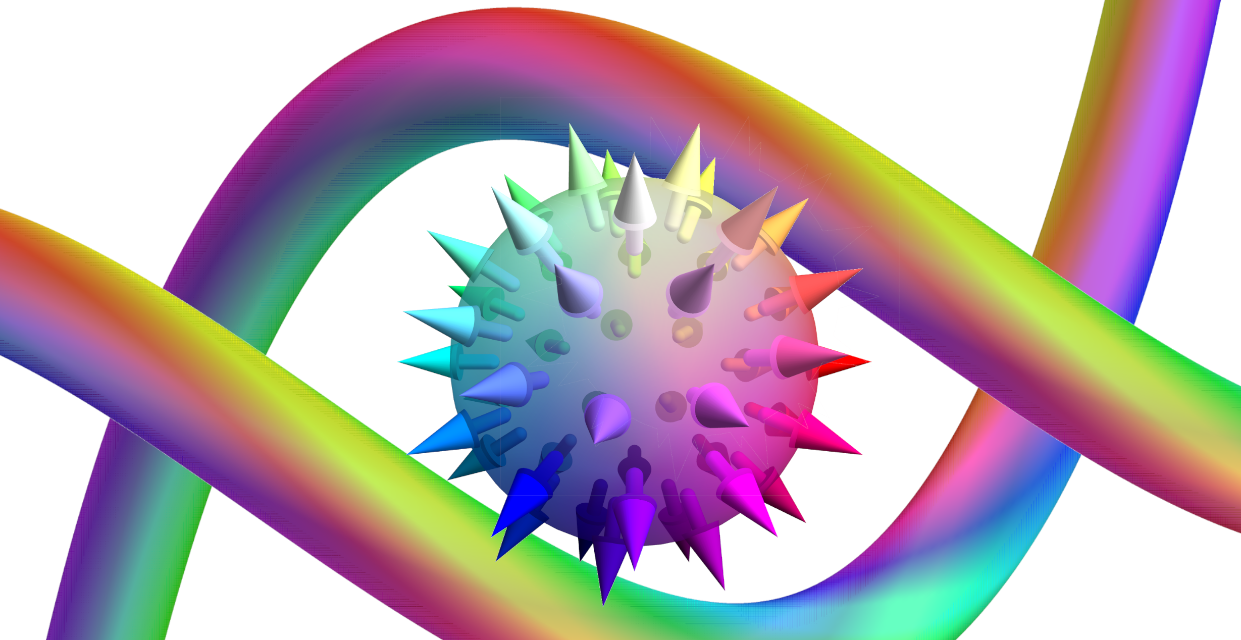
The Emmy Noether Research Group Masell develops theoretical and computational methods to understand, predict and control complex magnetic textures. Our central focus is magnetism in three spatial dimensions, where topological structures such as skyrmion strings, hopfions and magnetic defects exhibit properties that have no direct counterpart in two-dimensional systems.
We combine analytical theory, large-scale micromagnetic simulations, and close collaboration with experimental groups to investigate how these structures form, move and interact. Beyond three-dimensional magnetism, we explore unconventional magnetic order—including altermagnets and odd-parity magnets—and its consequences for domain walls, spin transport and magnetization dynamics.
Whether the formation, stability, or dynamics of complex magnetic structures, from three-dimensional topological textures to novel forms of magnetic order on the atomic scale – we at the ENG Masell cover a broad variety of topic in magnetism and working jointly with our experimentalist partners in close collaborations.

We investigate topological structures whose magnetization varies in all three spatial dimensions. These include skyrmion strings, hopfions, Bloch points, and other magnetic defects. Our goal is to understand their stabilization, topology, and experimental signatures.

How do three-dimensional magnetic textures move under the influence of currents, fields, or thermal excitations? We develop theoretical descriptions and numerical methods to investigate their dynamics, interactions, and potential applications in future information technologies.

Altermagnets and odd-parity magnets combine compensated magnetic order with characteristic spin-dependent electronic properties. We investigate their domain walls, excitations, transport phenomena, and magnetization dynamics.
News from the Emmy Noether group Masell. →More

Somasree is at the German Conference of Women in Physics 2026, presenting her work on Strain-induced Control on Topological Magnetic Textures in Antiskyrmion Hosting Material in contributed talk. The purpose of this special conference is to provide a safe space for women from all areas of physics to network and interact.
2026/09/28

In collaboration with the group of Prof. Jonathan Leliaert at Uni Ghent, Nicolai and Jan wrote and tested an extension for MuMax+. Adding a new object class for d-wave altermagnets, it is now possible to natively simulate the magnetization dynamics in MuMax+. This functionality has already been added to be main branch of MuMax+.
APL Computational Physics 2, 031101 (2026)
2026/09/11

In collaboration with a large team around the group of Prof. Max Hirschberger von der Uni Tokyo, Jan dazu could contribute to the first identification of a real-space g-wave valence electron distribution. This is the first measurement of a local real-space g-wave order parameter, proving the CrSb to be a g-wave magnet. The preprint is now on arXiv and currently under review.
2026/09/02

Using a simple model, Somasree and Jan calculated how the helical phase orients in a chiral magnet whose size is only a few helical wavelengths. The analytical and numerical results were complemented by experiments from the group of Prof. Dennis Meier (Uni Duisburg-Essen and NTNU Trondheim), showing excellent agreement.
2026/09/01

Nicolai and Somasree participate in the Summer School ESM organised by the European Magnetism Association EMA. For the next two weeks, they will attend numerous lectures by prominent colleagues and a poster session for the participants, located at the university of Uppsala in Sweden.
2026/08/17

We welcome Max Hirschberger as our guest in the ENG Masell! Max is a professor for Experimental Condensed Matter Physics and Materials Science at Uni Tokyo and head of a research group at RIKEN Center for Emergent Matter Science. He's an expert for transport measurements in magnetic materials and long-term partner of ENG Masell with numerous collaborations. We're looking forward to his talk!
2026/08/12
Our Team

Out independent junior research group unites expertise in analytical theory, numerical micromagnetism, magnetization dynamics, and novel magnetic materials.
Learn more out our team members: →Team
Publications
Highlights from our group:
Simulating altermagnets using mumax+,
L. Moreels, N. T. Bechler, B. Van Waeyenberge, J. Leliaert, and J. Masell,
APL Computational Physics 2, 031101 (2026) "Editor's Pick" (arXiv preprint)
Control of helix orientation in chiral magnets via lateral confinement,
M. Colling, M. Stepanova, M. Hentschel, S. Bhattacharjee, E. Lysne, K. Hunnestad, N. Kanazawa, Y. Tokura, J. Masell and D. Meier,
Commun. Phys. 9, 283 (2026) (arXiv preprint)
A metallic p-wave magnet with commensurate spin helix,
R. Yamada, M. T. Birch, P. R. Baral, S. Okumura, R. Nakano, S. Gao, M. Ezawa, T. Nomoto, J. Masell, Y. Ishihara, K. K. Kolincio, I. Belopolski, H. Sagayama, H. Nakao, K. Ohishi, T. Ohhara, R. Kiyanagi, T. Nakajima, Y. Tokura, T.-h. Arima, Y. Motome, M. M. Hirschmann, M. Hirschberger,
Nature 646, 837-842 (2025) (arXiv preprint)
Explore the full list: →Publications
Interested?
Join Us
The Emmy-Noether Group Masell offers specificall taylored topics for Bachelor theses, Master theses, PhD theses, and postdocs. We also offer internships for physics students. Contact us and together we check the possibilities.
Current job vacancies: tba.
Collaborations
Want to collaborate with us? Whether theory or experiment, we're open for all inquiries. Contact Dr. Jan Masell.
Press
Contact Dr. Jan Masell.
Funding
 Our group receives funding from the Deutsche Forschungsgemeinschaft (DFG) within the Emmy-Noether Programme (Project title "Design and Functionalization of 3d Magnetic Textures" or short "MAGN3D", Project number 547968854).
Moreover, our proposal "Magnetic Textures in Altermagnets and Antialtermagnets (MALTEX)" was granted as part of the DFG priority programme SPP2558 "Unconventional Magnetism: Beyond the s-wave paradigm". More details will be announced soon.